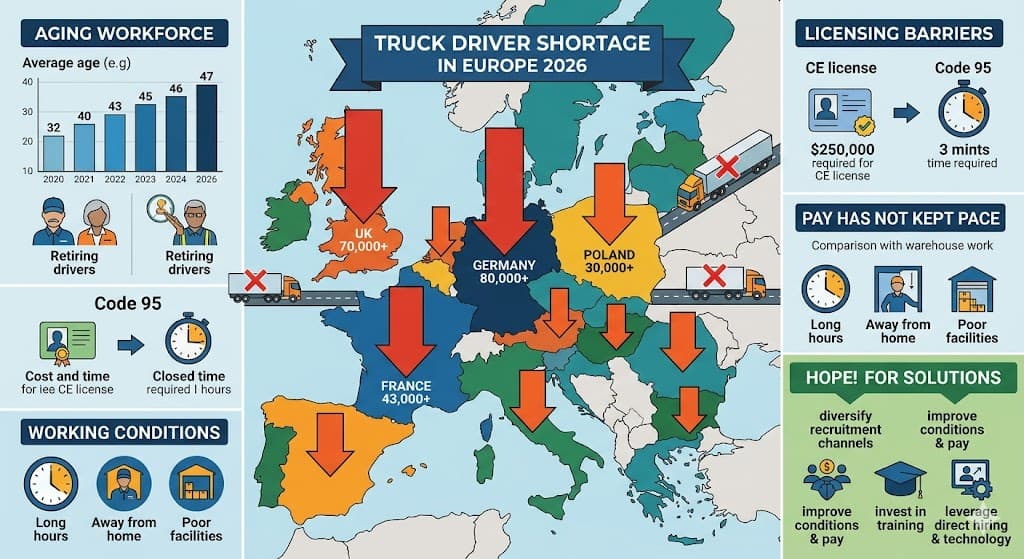
Europe is short more than 400,000 truck drivers. That number, reported by the International Road Transport Union (IRU) in its 2024 Driver Shortage Report, has grown every year for the past decade. The shortage affects the entire continent — from Germany (80,000+ unfilled positions) to the United Kingdom (approximately 70,000) to Poland and beyond. Every market is feeling the impact as workforces age and demand grows.
For transport companies, logistics operators, and fleet managers, the shortage is no longer a distant concern. It is affecting operations today: delayed deliveries, rising labour costs, and increased reliance on expensive subcontractors. This article examines the scale of the problem, its root causes, and the practical steps companies can take to secure drivers in 2026 and beyond.
The Shortage by Country
The driver shortage is a continent-wide issue, but its severity and causes differ by market.
| Country | Estimated Shortage | Avg. Driver Age | Key Pressure |
|---|---|---|---|
| Germany | 80,000+ | 47 | Retirement wave, low new entrants |
| United Kingdom | 70,000+ | 48 | Post-Brexit workforce reduction |
| France | 43,000+ | 46 | Competition from other sectors |
| Poland | 30,000+ | 45 | Growing demand, aging workforce |
| Spain | 25,000+ | 48 | Low wages relative to living costs |
| Italy | 20,000+ | 49 | Aging population, regulatory complexity |
| Netherlands | 15,000+ | 46 | Small domestic workforce, high demand |
| Romania | 15,000+ | 44 | Driver emigration, low domestic pay |
| Czech Republic | 8,000+ | 46 | Emigration, manufacturing competition |
Germany has the largest absolute shortage. The Bundesverband Güterkraftverkehr (BGL) reports that approximately 30,000 drivers retire each year, while only 15,000 new drivers enter the profession.
The United Kingdom faces a compounded problem. Brexit changed the dynamics of cross-border driver recruitment. The Road Haulage Association (RHA) reports only partial recovery since the 2021 peak of 100,000+ vacancies.
Poland now faces its own domestic shortage as demand for freight transport grows and its workforce ages. Cross-border opportunities have added to the challenge of retaining drivers domestically.
Why the Shortage Exists
The driver shortage has multiple interconnected causes. Understanding them is essential for developing an effective response.
Aging Workforce, Insufficient Replacement
The average European truck driver is 47 years old, according to IRU data. In several countries, including Spain, Italy, and the UK, the average exceeds 48. Meanwhile, fewer than 7% of new entrants to the profession are under 25.
The pipeline of new drivers is not keeping pace with retirements. Obtaining a CE license costs EUR 3,000 to EUR 6,000 and requires several weeks of training, a significant barrier for young workers.
Working Conditions
According to a 2024 Transport Intelligence survey, the top reasons drivers consider leaving:
- Too much time away from home (52%)
- Insufficient pay relative to demands (48%)
- Poor facilities at rest stops and loading points (41%)
- Lack of respect from management (38%)
- Health concerns from sedentary work (29%)
These factors are harder to overlook as alternative jobs (warehouse work, delivery driving) offer comparable pay with more predictable schedules.
Pay Has Not Kept Pace
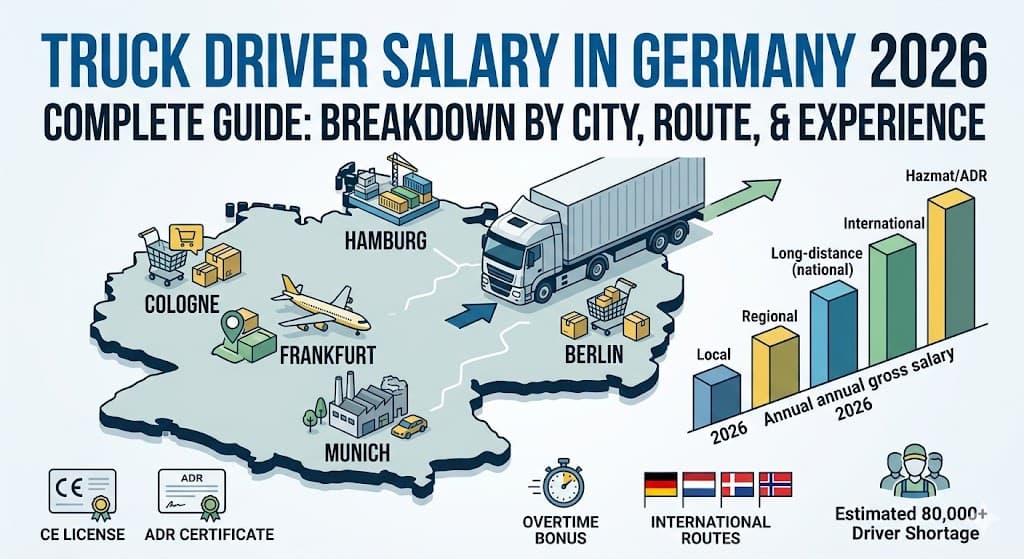
In Germany, the average truck driver earns approximately EUR 34,800 per year. Warehouse operatives in the same logistics centres earn EUR 30,000 to EUR 32,000 with no time away from home. The salary gap has narrowed, making it harder to justify the lifestyle trade-offs of long-haul driving.
Licensing Barriers
CE license training costs EUR 1,500 to EUR 6,000 depending on the country and takes 3 to 8 weeks. Some governments now offer subsidies for career changers, but these programmes have not yet closed the gap.
Impact on Supply Chains
The driver shortage has direct consequences for transport costs and supply chain reliability.
According to the IRU/Ti/Upply European Road Freight Rate Benchmark, contract freight rates continued to rise in 2025, while operating costs climbed further due to toll increases (Germany’s truck toll rose 83% in 2024) and rising labour costs. Companies unable to secure drivers at contract rates increasingly turn to spot market subcontractors at premium prices.
Beyond cost, the shortage contributes to longer lead times and greater operational risk. When key drivers are unavailable, the average time to hire a qualified replacement is 6 to 8 weeks.
What Companies Can Do
The shortage is structural and will not resolve itself. Companies that take proactive steps now will be better positioned than those waiting for the market to correct.
1. Expand Recruitment Across Borders
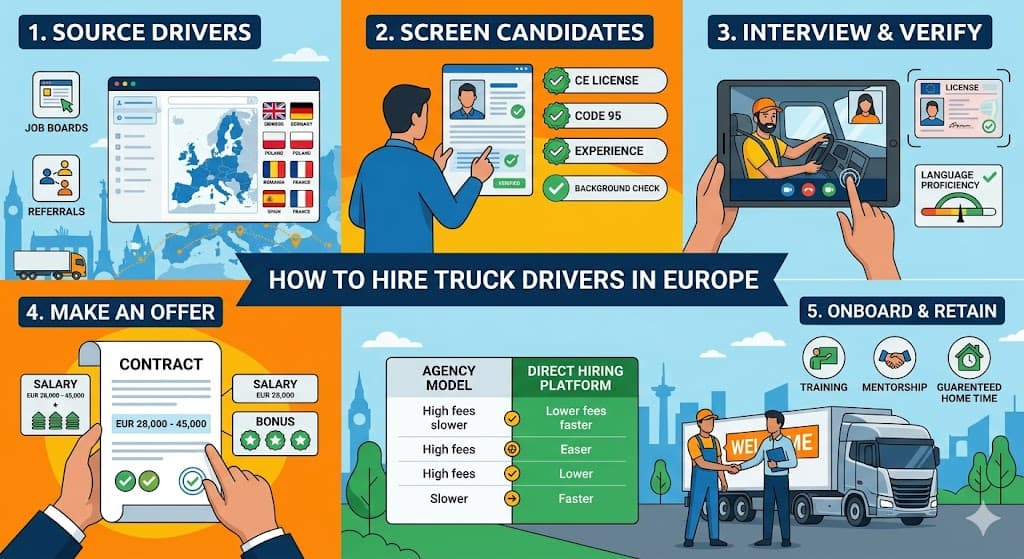
Cross-border hiring is the single most effective short-term response to the driver shortage. Europe has experienced, CE-licensed drivers actively seeking new positions across the continent.
Poland, Romania, Czech Republic, Hungary, and the Baltic states represent the largest available talent pools. Under EU freedom of movement, hiring from these countries requires no work permits, and CE licenses are mutually recognized across all member states.
2. Improve Pay and Conditions
Research from the National Academies shows that meaningful pay increases combined with guaranteed home time can cut driver turnover significantly — in one documented case, approximately in half. Modern vehicles, transparent bonus structures, and proactive communication also make a measurable difference.
3. Invest in Training and Licensing
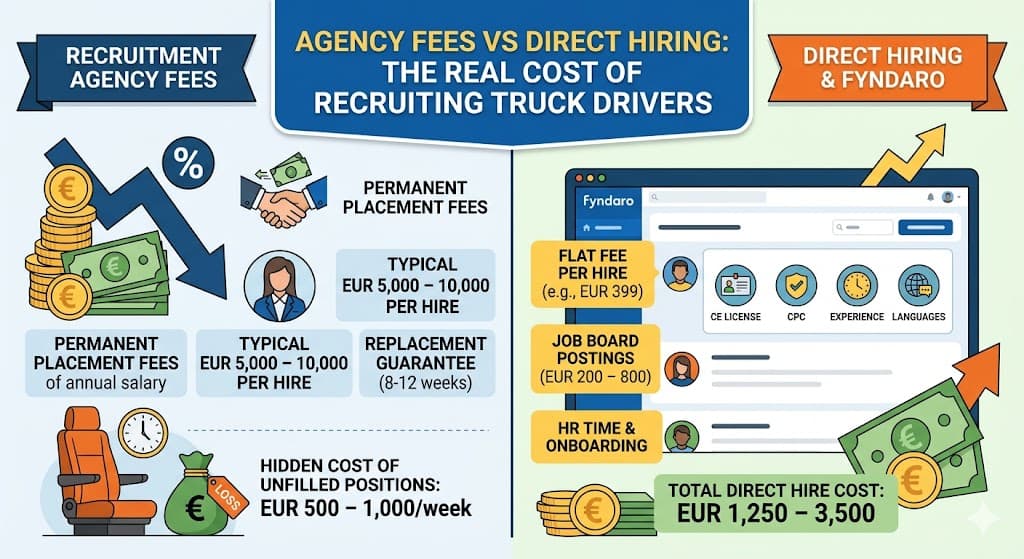
Sponsoring CE license training for new drivers is an investment that pays for itself within months. The cost of training a new driver (EUR 3,000 to EUR 6,000) is significantly less than the cost of an unfilled position or agency recruitment fees (EUR 5,400 to EUR 9,000 per hire).
Several forward-thinking companies in Germany and the Netherlands now offer “earn while you learn” programmes, paying trainees a reduced salary during their licensing period in exchange for a minimum commitment of 12 to 24 months.
4. Leverage Technology and Direct Hiring
Telematics, route optimization, and fleet management software improve both driver productivity and satisfaction. Digital documentation reduces administrative burden at border crossings.
On the recruitment side, shifting from agencies (15% to 25% of annual salary per hire) to direct hiring platforms dramatically reduces cost.
Looking Ahead
The European truck driver shortage will not be resolved quickly. Demographic trends, the time required to train new drivers, and competition from other sectors all point to continued pressure through at least 2030.
Companies that act now, by diversifying their recruitment channels, improving conditions, and embracing cross-border hiring, will be better positioned to maintain reliable operations. Those that continue relying solely on traditional methods will face escalating costs and increasing difficulty finding qualified drivers.
The data is clear. The question is not whether to adapt, but how quickly.
Frequently Asked Questions
Europe faces a combined shortage of over 400,000 truck drivers in 2026, according to the IRU. The largest gaps are in Germany (80,000+), the United Kingdom (70,000+), and France (43,000+). The shortage is projected to grow as current drivers retire faster than new ones enter the profession.
The shortage is driven by multiple factors: an aging workforce (average driver age is 47), insufficient new entrants, demanding working conditions, pay that has not kept pace with alternative employment, and the cost and time required to obtain a CE license. In the UK, Brexit further reduced the available workforce.
The shortage has pushed European road freight rates up by 8% to 12% between 2024 and 2025. Companies face higher costs for both contract and spot market haulage, longer delivery lead times, and greater operational risk from driver unavailability.
Cross-border hiring is the most effective short-term solution. Europe has experienced drivers seeking new opportunities across the continent. Under EU freedom of movement, no work permits are required, and CE licenses are mutually recognized. Platforms like Fyndaro facilitate direct cross-border hiring across 25 countries.
The most effective strategies include: offering above-market pay with transparent bonus structures, providing predictable schedules with guaranteed home time, maintaining modern vehicles, investing in driver training programmes, and using direct hiring platforms to reduce recruitment costs. Companies combining these approaches see 25% to 35% lower turnover than industry averages.
Access Verified Drivers Across 25 Countries
The driver shortage requires a broader, more proactive approach to recruitment. Fyndaro connects transport companies directly with verified truck drivers across 25 European countries, with no agency fees and no middlemen.
Start Building Your Driver PipelineUseful Resources
- IRU Driver Shortage Report — Global driver shortage data
- EU Driving Time Regulations — Official driving hours rules
- Eurostat Road Transport Statistics — EU freight transport data
- Bundesagentur für Arbeit — German employment agency
- BGL (German freight association) — German road haulage association
- Truck Driver Jobs in Europe — Browse jobs across 25 countries
- Hire Truck Drivers in Europe — Find verified drivers